


BGZ Dental Turkey
Loss of teeth is a major problem of dental health that severely affects the masticatory functions, speech, and cosmetic appearance of the people. In circumstances where standard treatment procedures are insufficient, All-on-four dental implant application is a dependable and durable therapy alternative for full edentulism. This procedure is a treatment protocol that has gained prominence in dental implantology in recent years and whose clinical success rates have been demonstrated by scientific investigations.
What is All-on-4?
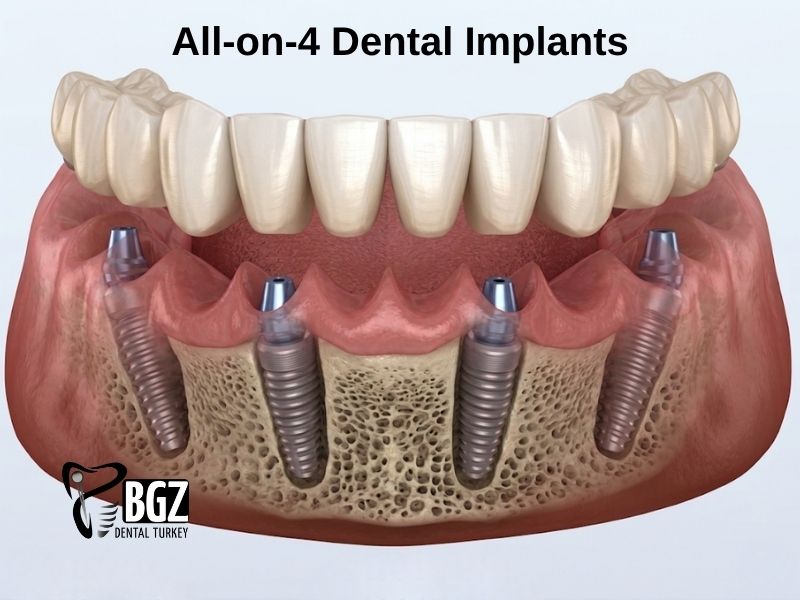
The All-on-4 dental implant Antalya surgery is a novel technique for the fully edentulous patient, those with numerous missing teeth, or people at risk of tooth loss. In this technique, four implants are used (two vertical and two angled) and implanted into the jawbone to support a fixed prosthesis, thus maximizing the existing bone support and usually removing the need for bone grafting.
How are four implants placed?
For the upper jaw:
- 2 flat implants are placed in the front
- In the posterior part, 2 implants are placed at an angle of 45 degrees (to avoid damaging the sinuses)
For the lower jaw:
- Posterior implants are placed at a special angle to protect the nerves
- Natural-looking, sturdy teeth are attached to it
Is bone volume important for all-on-4?
To be successful with the All-on-four therapy, you must have enough amount and quality of bone tissue in your jaw.
For the maxillary:
In the anterior region, at least 10 mm long and 4-5 mm wide. Posteriorly, a minimum bone height of 5 mm below the sinus cavity is necessary. The bone structure should neither be excessively firm nor too soft.
Lower jaw (mandible):
The anterior portion should be at least 6 mm wide and 12 mm long. In the posterior region there should be at least 4 mm of bone over the nerve line. Prefer good to moderate bone density.
In which cases can All-on-4 be applied in Antalya?
Edentulousness, complete:
All on four Antalya therapy is a good solution for individuals who have lost most of their teeth or who are in such a bad way that their teeth can no longer be preserved.
Loss of bone:
All-on-four implant therapy is a suitable option for patients with substantial bone loss, particularly in the posterior jaw region. This technique leads to maximal efficiency of the existing bone tissue and also provides the potential of therapy without the need for long-term and expensive additional treatments such as further bone grafting.
The All-on-4 approach can be successfully performed also in jaw structures with extensive bone resorption.
H-4. Cases with anatomical obstacles:
All-on-4 is a useful alternative in circumstances where traditional implants cannot be applied because of anatomic impediments. It reduces the need for bone grafts and offers functional support in overcoming anatomical restrictions.
- Mandible: Anterior implants are angulated at 30-45° to prevent the mental nerve. This approach offers stable implant support without harming the inferior alveolar nerve canal.
- Maxilla (upper jaw): Tilt implant application is done to avoid the entry into the sinus cavity. The angulated insertion of the sinus membrane of the maxilla protects up to 45°.
Seeking a rapid and stable solution:
With the Antalya All-on-four technique, a fixed temporary prosthesis can be placed immediately, within 24 hours following surgery. This advantage of “rapid rehabilitation” gives great clinical benefit, especially to patients who want a quick solution to their edentulism condition.
When dissatisfied with traditional dentures:
All-on-4 is a fixed, implant-supported solution that can considerably assist people who are unhappy with the functioning, comfort, and appearance of their existing removable dentures.
Effort to reduce costs and number of surgeries:
Regular full-arch implants generally need more implants and bone grafting. All-on-4 is a less expensive and perhaps less intrusive option, with 4 implants and little to no grafting needed.
Who is not a good candidate for All-on-4?
All-on four implant treatment Turkey is a great solution for many, but it does not work for everyone. Candidates not suitable for All-on-4 therapy include:
Patients with insufficient bone support:
- Patients with severe bone resorption lacking minimal bone volume to support implants
- Conditions when enough stability cannot be achieved even with the use of bone graft
Individuals with uncontrolled systemic illness
- Diabetes (HbA1c > 7) can interfere with the healing process.
- Osteoporosis - bone density can impact on implant success
- People with a compromised immune system (cancer patients, organ transplant recipients)
- Uncontrolled bleeding disorders or heart disease
Poor oral hygiene
- Advanced gum disease (receding gums)
- Smokers postpone healing and diminish chances of success.
- Patients who do not have regular dental care and do not go to doctor controls
Those with bruxism (teeth grinding)
Severe clenching habits can cause excessive pressure on the implants, leading to failure
Psychologically unprepared
Patients with unrealistic expectations,
People who cannot adapt to implant care
How is All-on-four treatment applied in Turkey?
The All-on-4 treatment concept is performed according to a specified protocol with surgical and prosthetic treatments according to a precise plan. This technique uses only four implants for comprehensive arch rehabilitation.
Planning the treatment:
- The patient’s general health is evaluated. A clinical examination is performed, and radiographic examinations (panoramic X-ray or tomography CT scan) are taken to evaluate the height, width, and quality of the bone.
- Choice of the right All on four technique based on available bone (standard, hybrid, or double zygoma).
- Plan the position and angulation of the implants. The posterior implant screw entry holes should be at the occlusal plane of the first or second premolar or first molar.
- Assessing the patient’s smile line and vertical occlusal dimension.
- 3D software is employed if a planned operation is directed.
- Planning can be done using the existing or immediate prosthesis of the patient.
Operation:
- If required, flap removal or a flapless method is used.
- Prepare the jawbone for the implants. The All-on-four implant guide is used to establish the correct posture and angulation if necessary. Posterior locations can be drilled at angles up to 45°.
- The most important factor in this phase is to obtain a sufficient primary stability of the implant to allow quick loading. If stabilization is not possible, the conventional healing procedure is anticipated.
- Where extraction sites are present, these are cleansed properly, and the implants are inserted between the extraction sockets, if possible.
Abutment junction;
After implant insertion, straight or angled (17° or 30°) multi-unit abutments are connected to them to rectify the angle and position the screw access holes of the prosthesis in the correct spot. If the implants are slanted 30° or more, splinting may be required.
Loading of temporary dentures:
- An acrylic temporary fixed prosthesis is manufactured and screwed to the implants immediately after placing the implants, on the day of surgery.
- This interim prosthesis can be constructed either by taking postsurgical measurements or by altering an existing immediate prosthesis. The prosthesis is fabricated with abutment analogues, interim copings, guide pins/lab screws, and acrylic.
- The temporary prosthesis acts as a splint that links the four implants together.
- ‘Immediate loading’ phase – patients can have a fixed prosthesis on the day of surgery, thereby reducing treatment time (‘time-to-teeth’).
- Adjustment of temporary denture according to masticatory function. The distal (posterior) cantilever should not have any occlusal contact.
Healing and follow-up
- Osseointegration is an important part of the procedure, as the implants should integrate with the bone. The patient is under constant observation. Postoperative problems are mostly caused by overloading of the temporary prosthesis (e.g., fracture of the denture or loosening of the abutments). These problems are solved rapidly.
- After the healing, the patient is given a permanent fixed denture that is more durable and beautiful and screwed to the implants by means of multi-unit abutments.
What should you take care of after All-on-four dental implants treatment?
You need to be in good overall health and maintain proper oral hygiene in order for the therapy to be successful. The post-treatment phase also warrants effective home oral care. Your dentist will tell you the cleaning methods that are particular to your prosthesis type (fixed or detachable) and your oral structure. Overall, implant-supported dentures are more convenient than traditional dentures.
- Regular follow-up sessions with your dentist are very important to confirm that your treatment is working and to monitor your dental health. These sessions are specifically to examine the effectiveness of home care so that patients can be looked after in their own homes and receive the greatest care.
- A fixed temporary denture is normally put into the implants the same day as the surgery. Overload or unstable occlusal contacts may lead to fracture of the temporary denture or loosening of the abutments. Therefore, observe your physician's recommendations very carefully with regard to chewing or biting with the temporary denture and be particularly careful not to place excessive pressure on the posterior (distal) extensions.
- It is common to have some swelling or bruising during the first ten days after surgery. However, if you observe any fracture of the denture or if you have any discomfort or a feeling of looseness when biting down, you should visit your dentist as soon as possible. These may be related to overloading of the denture or occlusal imbalances.
Advantages and disadvantages of All-on-4:
Advantages:
- Unlike traditional implants that need months of healing, All-on-4 often enables quick loading (a temporary prosthesis is implanted on the same day).
- Patients go home with working teeth, not protracted periods of edentulism.
- The All-on-four implant technique involves the placement of four implants in each jaw, decreasing surgical complexity compared to 6-8 implants per jaw required for full-arch restorations.
- The last two implants are put at an angle (30-45°) to maximize contact with the available bone, even in patients with moderate bone loss.
- This generally eliminates the need for sinus lifts or bone transplants, decreasing treatment time and cost.
- Cost is less than full-arch individual implants since fewer implants are needed and bone grafting is frequently not required.
- Patients recover 80-90% of their normal bite strength, enabling them to easily eat most meals.
- All-on-4 is not removable; it is set, so there is no slippage or pain.
- Prevents bone resorption (shrinkage of the jawbone) and helps maintain facial features and prevent a “sunken” appearance.
- The prosthesis resembles natural teeth, improving the appearance of the grin.
- Cleaning is easier than with removable dentures—patients can brush and floss normally (particular care needed around implants).
Disadvantages:
While there are many advantages and benefits of the All-on-four treatment in Antalya concept, there are also some probable disadvantages, limitations, and challenges:
- Patients with severe bone loss (especially in the front of the jaw) may still need bone transplantation.
Heavy smokers or uncontrolled diabetics may have greater failure rates.
- A failed implant may require extra surgery (usually owing to poor osseointegration).
- The success of the complete prosthesis depends on the success of all four implants.
- The first prosthesis (placed the same day) is usually acrylic and not as durable as the final zirconia or porcelain one.
- Some individuals have difficulty adjusting their speech and chewing as they heal.
- After a few years the acrylic temporary prosthesis may need to be updated.
- The final prosthesis (often zirconium) is more durable but may require maintenance or modification over decades.
- Unlike removable dentures, All-on-4 is fixed, and hence, adjustments must be done by a dentist.
- If the bite feels weird, it may need to be professionally adjusted.
All-on-4 Cost:
Prices can vary based on the clinic, the city, the materials used, and the level of therapy; hence, average ranges are given:
Country Price Range (Euro)
Turkey: 4,000-7,000€
UK: £15,000 - £25,000
USA: 20,000 - 30,000 €
Germany: €12,000-20,000
F.A.Q.:
Is the All-on-four procedure painful?
Since the procedure is performed under local anesthesia, no pain is felt during the procedure. There may be mild pain and swelling during the recovery period; these are normal.
What materials are used for All-on-4?
Implants are made of titanium or titanium alloys; prosthetic teeth are made of durable materials such as acrylic, porcelain, or zirconium.
How long is the All-on-four treatment time?
Implant placement usually takes 1-2 hours. Temporary prostheses can be worn the same day, but it may be necessary to wait 3-6 months for a permanent prosthesis.
How long does All-on-four last?
With proper care and regular checkups, it can be used for 20 years or more without any problems.
Can the dentures be removed?
All-on-four dentures are usually fixed, i.e., not removable. However, cleaning is easy, and oral health is maintained with professional care.
Are aesthetic results achieved with All-on-4 treatment?
The shape, color, and alignment of the teeth are planned individually. Natural and aesthetic results are achieved with smile design.
Is there any difference between All-on-4 implants and normal teeth?
Visually and functionally, it gives results very close to natural teeth. However, it is necessary to pay more attention to oral hygiene..
What is the best eating plan following an All-on-4 procedure?
- After the placement of All-on-4 dental implants Turkey, it is recommended that you follow your dentist's advice to manage the healing process well and prevent swelling and bleeding.
- For the first 2 weeks, liquid or pureed food should be eaten, neither too hot nor too cold.
- First 15-30 days: pasta, rice, cereals, eggs, fish, finely chopped vegetables, and soft fruits should be eaten.
- 2nd month and onwards: A normal diet should be observed, and hard foods should be avoided.
With our guaranteed treatments, we are always here for you.
Don’t hesitate to contact us, We will be happy to help anytime.