



BGZ Dental Turkey
What is a temporary tooth filling?
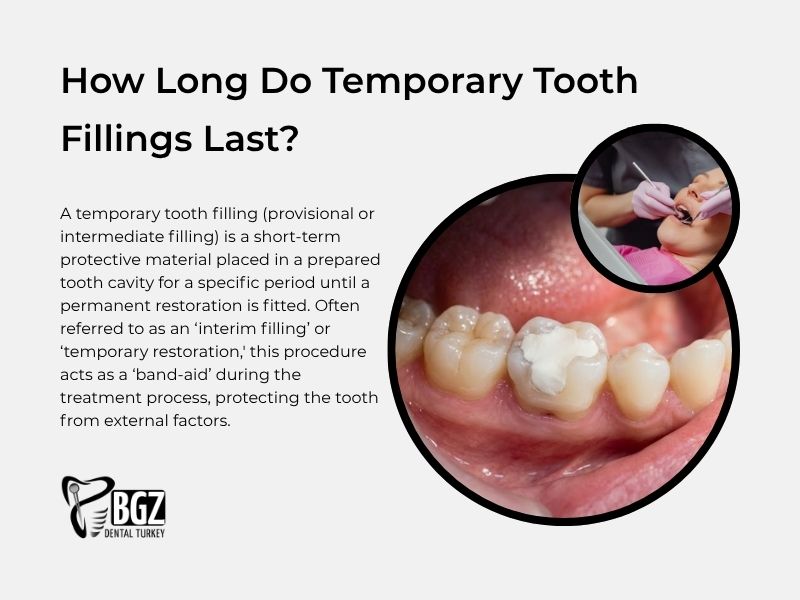
A temporary tooth filling (provisional or intermediate filling) is a short-term protective material placed in a prepared tooth cavity for a specific period until a permanent restoration is fitted. Often referred to as an ‘interim filling’ or ‘temporary restoration,' this procedure acts as a ‘band-aid’ during the treatment process, protecting the tooth from external factors.
What is the purpose of a temporary tooth filling?
Dentin-pulp protection
The primary purpose of a temporary filling is to seal off the nerve tissue (pulp) inside the tooth against external factors.
Sealing:
It prevents infection by sealing the cavity against food debris, saliva, and bacteria.
Prevention of sensitivity:
If the cavity is left open, external stimuli such as hot or cold food can cause very brief, sharp pains; a temporary filling prevents this sensitivity.
Control of inflammation:
Prolonged exposure of the dentine can lead to pulp inflammation; a temporary filling minimizes this risk.
Soothing of dental nerves (Sedation)
It is used, particularly in cases of deep decay or emergencies, to allow the tooth time to recover. Materials such as zinc oxide eugenol have a soothing effect on the dental nerves and help to relieve pain.
Preservation of the bite and tooth structure
Preventing tooth movement:
A missing tooth may, over time, tilt, shift, or cause a tooth in the opposing jaw to grow into the gap (over-eruption). A temporary filling helps to stabilize the tooth’s position, thereby preserving the bite (occlusion).
Support against fracture:
Teeth that have undergone root canal treatment are prone to fracture under chewing pressure as they weaken due to loss of water; a temporary filling provides structural support to the tooth during this process.
Protection of the periodontal tissue
Particularly in the spaces between two teeth (Class II cavities), if a temporary filling is not placed, food can become trapped. This can lead to complications and pain in the gums; the temporary filling protects the gums by filling this space.
Diagnosis and observation process (Wait-and-see approach)
Dentists sometimes place a temporary filling to monitor the condition of a tooth. During this process, they assess whether the toothache has subsided to determine whether root canal treatment is required.
Facilitating the transition between treatment processes
Root canal treatment:
In multi-session root canal treatments, it is used to protect the root canals from bacteria between sessions.
Laboratory preparation:
While waiting for restorations prepared in the laboratory, such as crowns, inlays, or onlays, it ensures the protection of the prepared tooth and prevents the gap between the teeth from opening up.
What materials are used in temporary fillings?
Temporary dental fillings are made from materials selected for ease of application and removal rather than durability and are used to protect the tooth until permanent restorations are placed. These materials are intentionally softer in texture compared to permanent fillings (such as amalgam or composite).
The primary materials used in temporary fillings are as follows:
Zinc oxide eugenol (ZOE)
This is the most commonly used temporary filling material.
- Traditional ZOE: Typically used on posterior teeth prior to amalgam restorations. It has a sedative effect on dental nerves.
- Modified ZOE (IRM – Intermediate Restorative Material): This is a form of traditional zinc oxide powder reinforced with additives such as silica, alumina, or ethoxybenzoic acid. These additives increase durability and reduce setting time. IRM is suitable for longer-term use (1–3 months).
Cavit
It is a moisture-sensitive material that hardens on contact with saliva.
- It provides excellent sealing of the cavity but is physically weak and wears down quickly.
- It is generally preferred for short-term (1–2 weeks) treatments.
Glass ionomer cement
Both traditional and resin-modified forms are available.
- Thanks to its fluoride-releasing property, it protects the tooth against new cavities (anti-cariogenic effect).
- It chemically bonds to the tooth structure but is more brittle than permanent fillings.
Eugenol-free materials
In some cases, materials containing eugenol are not preferred.
- Eugenol residues may interfere with the curing reaction of subsequent aesthetic resin (composite) fillings or bonding procedures.
- For this reason, single-piece paste systems free from eugenol are used in preparations on anterior teeth or in cases where the final restoration will be resin-based.
Resin-based materials
These are generally used in preparations for indirect restorations such as inlays, onlays, or temporary crowns.
- Both chemically and light-curing types are available.
- They possess significantly higher strength and hardness compared to other temporary materials.
Zinc polycarboxylate cements
This is another type of cement generally preferred for longer-term temporary fillings (up to 6 months).
Factors influencing the choice of temporary filling material
Your dentist selects the material based on the following criteria:
- Duration of use: If the filling is to last less than 2 weeks, ZOE or soft ready-made fillings are used; if it is to last longer, reinforced ZOE (IRM) or hard resins are selected.
- Cavity size: Standard ZOE is sufficient for small cavities, whilst modified ZOE or resin restorations, which are more durable, are required for larger cavities.
- Type of permanent restoration: ZOE is suitable for metal restorations, whilst eugenol-free materials are mandatory for non-metal aesthetic restorations.
- Vitality of the tooth: As teeth that have undergone root canal treatment become brittle due to loss of water content, materials with higher protective properties or full-coverage temporary crowns may be required.
How long do temporary tooth fillings last?
As the name suggests, temporary fillings are not a permanent solution and need to be replaced after a certain period of time. The lifespan of a temporary filling can vary from a few days to three months, depending on the material used and how well it is looked after.
Categories by duration
Temporary fillings are designed for different durations depending on the dentist’s treatment plan:
- Short-term: Typically placed to remain in the mouth for 1–2 weeks.
- Medium-term: Planned to last for several weeks.
- Long-term: When made with certain specialized materials, they can remain in the mouth for up to 6 months.
Durability by material type
The type of material used directly affects how long the filling will remain intact:
- Standard zinc oxide eugenol (ZOE): Generally softer in texture and lasts between 1 and 4 weeks.
- Reinforced interim restorative material (IRM): Has a more durable structure and can maintain its integrity for 1 to 3 months.
- Cavit: Although it has high sealing properties, it is physically weak and wears down quickly; therefore, it is generally preferred for very short-term treatments.
Factors affecting the lifespan of a temporary dental filling
The lifespan of a temporary filling depends not only on the material used but also on the patient’s habits and the position of the tooth:
- Tooth position: Temporary fillings in molars wear down or fall out more quickly than those in front teeth, as they are subjected to much greater pressure during chewing.
- Dietary habits: Sticky foods such as chewing gum and toffee can pull the filling out of place; hard foods such as nuts or ice can crack the filling.
- Oral hygiene: Vigorous brushing can wear down the soft temporary material. When using dental floss, sliding it out from the side rather than pulling it upwards helps extend the life of the filling.
- Filling size: Fillings used to fill larger cavities are more prone to breaking and falling out than those used for smaller ones.
- Teeth grinding (bruxism): In people who grind their teeth, the increased trauma on the temporary filling shortens its lifespan.
Why should they not be left in place for more than 8 weeks?
Most temporary fillings are designed to last an average of 6 to 8 weeks. Although they may remain in place for longer in some cases, exceeding this timeframe carries the following risks:
- Leakage: The material deteriorates over time, allowing bacteria to seep through and causing the inside of the tooth to become reinfected.
- New cavities: Food particles seeping under the filling can quickly lead to new cavities.
- Tooth loss: Fillings that are not replaced in time can result in the tooth needing to be extracted or the formation of an abscess due to a progressive infection.
When should you replace a temporary filling?
In most cases, a permanent restoration should be put in place within 6 to 8 weeks of getting a temporary filling.
Here are the reasons why a temporary filling needs to be replaced and the exact times when it needs to be done:
Change according to the schedule
Temporary fillings are made to last for varied amounts of time depending on what they are for:
- Short-term: Needs to be replaced in 1 to 2 weeks.
- Medium-term: It can stay in the mouth for a few weeks.
- Long-term: Some materials, like reinforced ZOE or zinc polycarboxylate, can endure up to six months, although this is not the case for all of them.
Clinical symptoms that need therapy
You should call your dentist right away if any of the following happen:
- Damage to the material: If you see cracks, a collapse, or a big change in color in the filler.
- Pain and swelling: If you feel new pain, swelling, or throbbing, for example, in the area where the filling is.
- More sensitive: If you become overly sensitive to hot, cold, or chewing pressure.
- Filling falling out or getting loose: If the filling has fallen out completely or become loose, you need to act right away because the tooth is now open to microorganisms and could get infected.
- Sharp edges: If the filling has worn down and created sharp edges that hurt your tongue or face.
Why should it be replaced in good time?
If you wait too long to replace something, you could run into the following problems:
- Bacterial leakage: Over time, temporary materials wear down and start to leak, which causes new cavities to form behind the filling.
- Infection and abscess: If the leak keeps happening, the infection can migrate to the deeper layers of the tooth, which can cause an abscess or loss of the tooth.
- Damage to the structure: If the tooth is not safeguarded, it may break when you chew on it.
How long can a temporary filling last compared to a permanent one?
Comparison of temporary vs. permanent fillings
|
|
|||||
|
|
|||||
|
|
|||||
|
Feature |
Temporary Filling |
Permanent Filling |
|||
|
Lifespan |
6–8 weeks on average. It can last anywhere from a few days to six months, depending on the substance. |
With the right care, this should last 5 to 15 years or longer. Usually lasts for at least ten years. |
|||
|
Common Materials |
Cavit, IRM, glass ionomer, or zinc oxide eugenol (ZOE). |
Composite resin, amalgam, ceramic, gold, or porcelain. |
|||
|
Durability and strength |
Weak; the materials are made to be softer and more delicate on purpose. |
Very strong; tough, long-lasting, and able to handle chewing forces over time. |
|||
|
Main goal |
to provide temporary protection, emergency help, and short-term sealing while therapy is still going on. |
Restoration of teeth for a long time and permanent recovery of function. |
|||
|
Removal Process |
The dentist can easily take it out when the permanent restoration is ready. |
Not meant to be taken out often; usually bonded or jammed tightly into the tooth. |
|||
|
Care Requirements |
Needs specific care, like not eating sticky or hard foods and brushing and flossing gently. |
Lets you eat normally and keep your mouth clean in a natural way. |
|||
How to care for a temporary filling?
Here are the key points to bear in mind regarding the care of your temporary filling:
The first 24–48 hours after the procedure
- Wait for the anesthetic to wear off: If you have had an anesthetic injection, avoid hot food and drink and chewing until the numbness has completely worn off; otherwise, you may bite your tongue or cheek without realizing it.
- Restrictions on the first day: To allow the filling to settle, do not chew on that side for the first 24 hours after the procedure, and avoid hot foods.
- Use of a straw: Avoid using a straw for the first one or two days; the suction created can put pressure on the filling.
Dietary habits
To prevent your temporary filling from breaking or falling out, you should make the following changes to your diet:
- Chew on the opposite side: Use the side of your mouth without the filling as much as possible to reduce pressure.
- Eat soft foods: Foods such as eggs, yogurt, smoothies, mashed potatoes, soft pasta, and cooked vegetables are safe.
- Things to avoid:
- Sticky foods: Chewing gum, toffee, taffy, and jelly sweets can pull the filling out of place.
- Hard foods: Nuts, ice, hard sweets, and raw carrots can crack the filling.
- Crunchy and crispy foods: Crisps and crackers can damage the integrity of the filling.
Oral hygiene and cleaning
- Gentle brushing: Brush the area around the filling very gently twice a day using a soft-bristled toothbrush. We recommend using a non-abrasive toothpaste.
- Special flossing technique: When flossing around the filling, do not pull the floss upwards to remove it. Instead, gently slide the floss sideways out from between the teeth. Pulling upwards may cause the filling to come loose.
- Saltwater rinse: To reduce gum sensitivity and bacteria, rinse with warm salt water 3–4 times a day or after meals.
Symptoms to watch out for
- Normal occurrences: It is normal for small pieces of the filling to break off. Additionally, sensitivity to hot or cold or mild pain may occur in the first 12–24 hours; in such cases, desensitizing toothpaste may be used.
- Emergencies: If the filling falls out completely, cracks, or becomes loose, contact your dentist immediately. The exposed tooth is vulnerable to infection, pain, and structural damage.
- Severe symptoms: If you experience severe pain, a fever, or swelling in the face, you should seek emergency dental care.
The importance of follow-up appointments
However safe a temporary filling may feel, it is never a permanent solution. These fillings are generally designed to last between 6 and 8 weeks (up to a maximum of 3 months). Missing your appointment can lead to new decay forming beneath the filling, infection and even tooth loss
F.A.Q:
Does a temporary filling cause pain?
Under normal circumstances, a temporary filling does not cause pain. However, pain may occur if there is an infection beneath the filling, if the filling is too high (and makes contact when biting), or if the nerve remains sensitive.
How long does a temporary filling typically last?
On average, it lasts between 2 and 8 weeks. The duration varies depending on the location of the filling, its size, oral hygiene, and chewing habits.
How long can a temporary filling remain in the mouth?
In some cases, it can remain in the mouth for up to 3 months, but it is not recommended to leave it in for a long period. Over time, it may leak, break, or cause secondary decay in the tooth.
What should you do if a temporary filling falls out?
If a filling falls out, you should contact your dentist immediately. Until you can get an emergency appointment, keep the tooth clean, avoid hard foods, and provide temporary protection using temporary filling kits available from pharmacies.
How can temporary fillings be distinguished from permanent fillings?
Temporary fillings are usually white, grey, or yellowish in color and have a softer texture. Permanent fillings, on the other hand, are made of composite (tooth-colored) or amalgam (silver-colored) and have a hard structure.
How long do temporary fillings last in children?
In children, they generally last 2–4 weeks, depending on oral hygiene and dietary habits. Care should be taken, as children may brush their teeth more vigorously or consume more sticky foods.
Does a temporary filling damage the gums?
It does not cause damage when applied correctly. However, if the edges are rough or if it has been applied too thickly so that it comes into contact with the gums, it may cause irritation. In this case, you should consult your dentist.
Is it dangerous to swallow a broken temporary filling?
Temporary filling materials are generally non-toxic and do not usually cause any problems if swallowed in small pieces. However, as there is a risk of the fragments entering the airways, the dentist should be informed and the filling replaced.
With our guaranteed treatments, we are always here for you.
Don’t hesitate to contact us, We will be happy to help anytime.