



BGZ Dental Turkey
In recent months, TV star Jenny McCarthy's health crisis has created a serious agenda in the dental world. In her appearance on Maria Menounos' Heal Squad podcast, the 53-year-old brought to light a condition that can happen to many patients but is frequently overlooked: the systemic spread of an untreated or incompletely cleaned root canal infection.
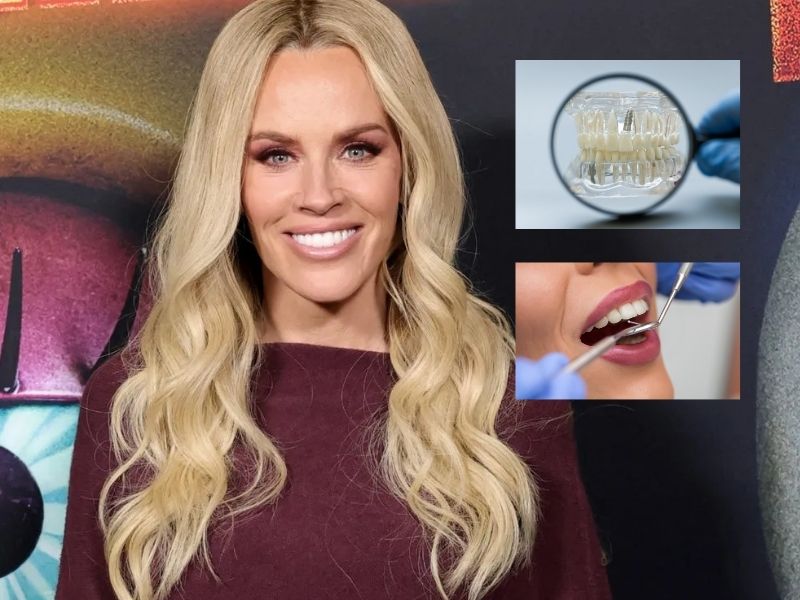
As a dentist examining this case, I can clearly see both the failures in the diagnostic process and how valuable this case is from a patient education standpoint.
She faced the public for the first time
McCarthy first shared this health crisis with the public in November 2025, just before Thanksgiving, in an exclusive interview with People magazine (source) — and what she described was deeply shocking.
"I've had nine surgeries this year, on my mouth. I had one infection that turned into another and another, and then I had these growths show up on my eyeballs."
— Jenny McCarthy, People Magazine, November 26, 2025
The story began with the failure of a ceramic dental implant. McCarthy said: "My teeth were falling out, implants falling out. They finally had to dig into my jawbone and chipped away, and found I had a deep bone infection. I've been on antibiotics for a year, and have had to eat soft foods only."
One striking detail from the interview was the holiday card she released with her husband — the couple looked extremely fit. But McCarthy admitted the truth behind that image: her slim figure was not the result of a healthy lifestyle, but of being unable to eat solid food due to a mouth full of stitches. "I had two more mouth surgeries even after that photo was taken. I've been pretty unlucky," she said.
As a dentist, the significance of this interview comes from this point: At that time, McCarthy had not yet been diagnosed with mycotoxin poisoning. The picture of "9 surgeries, falling teeth, eye lesions" was a snapshot of a period when the root cause — systemic mold poisoning from an infected root canal — was still unknown. The information she shared months later on the Heal Squad podcast filled in the missing pieces of this picture.
The Starting Point: An Incompletely Treated Root Canal
McCarthy learned that a root canal she had done in her 20s had not been fully cleaned out. Despite infection remaining in the canal, bone graft was placed on top of it, and McCarthy lived for many years unknowingly harboring a growing infection in her bone.
Evaluated from a clinical standpoint, this situation is unfortunately not rare. The most common reasons for root canal treatment failure include:
- Anatomical complexity: Some teeth have 3–4 canals; if all are not sterilized, bacterial colonization continues.
- Insufficient imaging: Conventional X-rays are 2-dimensional and can miss subtle infections in the apical region.
- Asymptomatic progression: Patients do not notice the infection growing because they feel no pain. This is the clinical picture we describe as a "silent infection."
Cavitations: The invisible threat inside the bone
McCarthy described how three separate toxic pools formed beneath her wisdom teeth, and that despite repeated cavitation surgeries, the infection simply would not clear.
Cavitation (osteonecrosis) refers to necrotic areas in the jawbone caused by disrupted blood flow. These areas:
- Accumulate bacteria, heavy metals, and toxins
- Are generally invisible on standard periapical X-rays
- Can be detected with Cone Beam Computed Tomography (CBCT)
- Can lead to systemic immune suppression
In McCarthy's case, it was stated that these toxic pools — containing heavy metals, toxins, and bacteria — were clearly visible on CBCT imaging. This point is critically important: while cavitations remain a controversial diagnostic category in conventional dentistry, they can now be objectively identified with appropriate imaging methods.
Implant rejection and the cyclical nature of infection
McCarthy reported that her implants were also rejected during the infection process, and that she underwent 9 oral surgeries in 2025 alone.
This cycle points to a well-known vicious cycle in dentistry:
Infection → Implant failure → Re-operation → New infection
Every implant attempt made without eliminating the underlying infection is doomed to fail. This is exactly where the biological dentistry approach comes in: first reduce the immune burden, then proceed to restorative treatment.
Eye lesions: Striking evidence of the oral-systemic connection
In the People interview, McCarthy described this picture as follows: "My jaw was swelling up and I was in massive pain, and at the same time I was getting these growths popping up on my eyeballs."
McCarthy described how recurring pus-filled lesions developed on her lower eyelid, and that despite being surgically removed, they reappeared every four weeks.
As a dentist, this picture is not surprising. The systemic manifestations of chronic oral infections are well documented in the literature:
- Eyes: Chronic blepharitis, chalazion (stye-like lesions), uveitis
- Cardiovascular system: Endocarditis, atherosclerosis
- Joints: Rheumatoid arthritis flare-ups
- Nervous system: Headaches, chronic fatigue
The diagnosis her doctors ultimately reached was mycotoxin poisoning — toxic mold exposure. This was identified as the reason for her persistent infections, inability to heal, and oozing symptoms. Oral cavitations had essentially served as a gateway for mold spores and mycotoxins to enter systemic circulation.
Clinical takeaways: What do we learn from this case?
1. Root canal treatment is not "done once, finished forever."
McCarthy said, "I didn't know that root canals don't last forever." This is a misconception shared by the vast majority of patients. Root canal treated teeth must be periodically monitored clinically and radiologically.
2. Absence of symptoms does not mean absence of infection.
Intraosseous infections in particular can remain silent for many years. In the presence of unexplained systemic symptoms — chronic fatigue, recurrent infections, immune suppression — dental foci must be thoroughly investigated.
3. CBCT imaging should complement standard X-rays.
In cases of suspected cavitation, 2-dimensional periapical radiography is insufficient. CBCT reveals intraosseous lesions with far greater precision.
4. The biological dentistry approach carries value.
McCarthy emphasized that being referred to a biological dentist was decisive in resolving her problems. Dental treatment that considers material biocompatibility, detox protocols, and systemic integrity makes a real difference, especially in complex cases.
Conclusion
Jenny McCarthy's case is a striking example of how problems dismissed as "just a tooth" can, over the years, devastate quality of life and affect the entire body. The journey from her first People magazine interview to the Heal Squad podcast illustrates just how slowly the diagnosis progressed and how late the systemic connections were recognized.
Mycotoxin poisoning, cavitations, implant rejection, eye lesions — all of it stemming from a single incompletely cleaned root canal — once again proves that oral health cannot be considered separately from systemic health.
I always tell my patients: Your mouth is the gateway to your body. Keep that gateway healthy.
Sources: People Magazine – Jenny McCarthy Exclusive Interview (November 26, 2025) | Maria Menounos – Heal Squad Podcast (March 2026) | Fox News Health, Entertainment Weekly, The Independent US
Disclaimer: This article is an independent editorial piece written from a clinical dentistry perspective. All information referenced from Jenny McCarthy's statements is based on publicly available sources, including her exclusive interview with People Magazine (November 26, 2025) and her appearance on the Heal Squad podcast with Maria Menounos. No original text has been reproduced verbatim; all references have been paraphrased and interpreted for educational and informational purposes only. This content does not claim any affiliation with, endorsement by, or representation of Jenny McCarthy, People Magazine, or any related parties. All rights to the original interviews and publications belong to their respective owners.
With our guaranteed treatments, we are always here for you.
Don’t hesitate to contact us, We will be happy to help anytime.