
Dr. Fevzi Büyükgebiz
Endodontist, Advanced Implant Surgery
Laser dentistry uses a focused beam of light instead of a traditional drill or scalpel for many common procedures, often meaning less pain, less swelling, and faster healing. Here is where it makes the biggest practical difference.
How Does a Dental Laser Work?
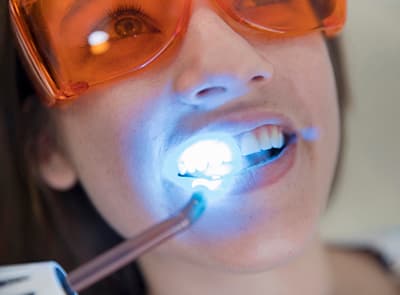
A dental laser delivers energy in a very precise, focused beam, which can cut, vaporise, or disinfect tissue depending on the wavelength and settings used. Because the beam is so precise, it can often treat only the tissue that needs treating, leaving more of the surrounding healthy tissue undisturbed than a traditional instrument would.
What Can Laser Dentistry Treat?
- Gum disease and gum contouring, removing inflamed or excess gum tissue with less bleeding than a scalpel
- Cavity preparation for small fillings, sometimes without the need for local anaesthetic
- Disinfecting root canals more thoroughly by reaching areas a file alone may miss
- Removing soft-tissue growths or performing a small frenectomy (releasing a tight lip or tongue tie)
- Teeth whitening, where the laser activates the whitening gel for a faster in-clinic result
- Reducing sensitivity by sealing exposed dentin on a sensitive tooth
Why It Often Hurts Less
Laser treatment on soft tissue typically causes less bleeding, since the laser seals small blood vessels as it works, and less swelling, since it disturbs less surrounding tissue than a blade or drill. Many soft-tissue procedures need little to no local anaesthetic as a result, and healing is often faster too.
Is Laser Dentistry Safe?
Yes. Dental lasers are calibrated to specific, tested settings for each procedure, and have been used in dentistry for decades. As with any dental tool, safe use depends on proper training, which is why laser-supported treatment is offered as one option among several, chosen when it is the right fit for the specific procedure.
What Laser Dentistry Cannot Replace
A laser is not a replacement for every instrument. Placing an implant, cementing a crown, or shaping a filling still relies on conventional tools, lasers are used specifically where their precision and gentler effect on soft tissue offer a genuine advantage, not as a universal substitute.
What to Expect if Your Treatment Uses a Laser
If a laser is used as part of your treatment, your dentist will explain why beforehand, most patients notice less discomfort during the procedure itself and a smoother first day or two of healing compared with a similar traditional procedure.
Laser Dentistry vs Traditional Treatment: A Quick Comparison
For the procedures where a laser is a genuine fit, gum contouring, small soft-tissue work, cavity disinfection, the main practical differences patients notice are less bleeding, less need for local anaesthetic, and a faster first day or two of recovery, compared with the equivalent traditional technique.
Frequently Asked Questions
Does laser treatment cost more?
It can, since laser equipment is a bigger investment for a clinic than standard hand instruments, but it is not automatically the case, ask your dentist whether it applies to your specific treatment plan.
Will I still need anaesthesia?
For some procedures, no, or less than usual. For others, particularly anything involving the tooth’s nerve, local anaesthesia is still used regardless of whether a laser or a drill is doing the work.